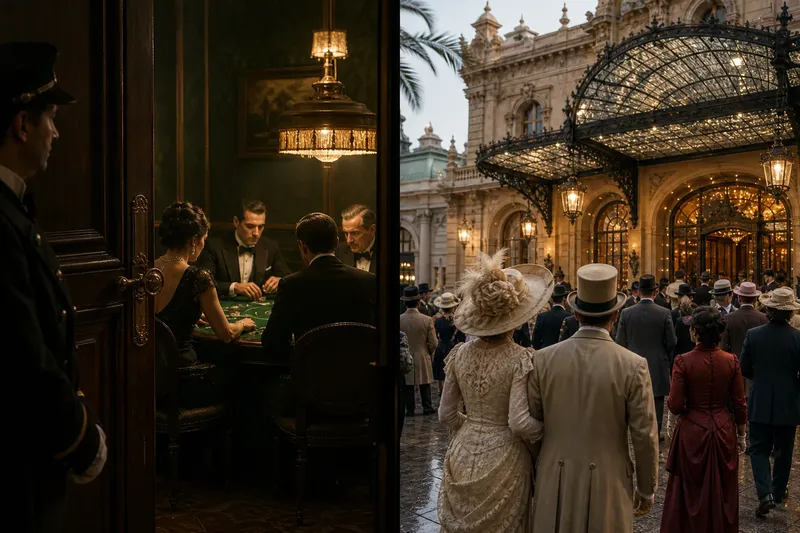
Roulette Layouts and Card Tables: Two Different Maps of Choice
See how roulette layouts and card tables present choices, uncertainty and the next action, so you can design clearer play surfaces without implying an outcome.
Where should a player look to understand a game’s choices? Roulette layouts and card tables answer that question differently: roulette gives categories a stable printed map, while a card table makes the current hand visible through cards and turn signals. Designing for both means choosing what the surface should help a player notice, not suggesting that it can predict a result.
Think of a labelled kitchen drawer: its compartments organise objects, but they do not decide what someone will pick. A game surface can organise attention in the same way.
Roulette layouts organise betting categories on a printed field
A roulette layout places numbered spaces beside broader groupings, such as colours, odd or even numbers, and low or high ranges. Lines, boxes and labels establish where each category belongs, so players can locate and compare options on the surface.
The layout is a map of recognised categories, not a forecast. A marker may show a selected area, but its location does not make that result more likely. Keep the marker visually distinct from the printed names and boundaries.
Card tables make the current hand visible through objects and position
At a card table, the arrangement of cards and indicators can communicate what has happened in a hand and whose turn is active. The rules define which actions are permitted; the table shows the information players need to apply them.
Give each physical cue one clear purpose. A marked area can hold cards that count towards the current hand, while a separate indicator can show the active player. Avoid using the same marker to stand for both a card’s status and a player’s turn.
Design the surface around the question players must answer
Before adding a label or marker, identify the decision it supports. A roulette surface may need to help someone locate a category; a card table may need to show whose turn it is and which information is relevant. Those are different jobs, so they need not share the same visual arrangement.
Use this review list while sketching or revising a play surface:
- Check whether category names remain in consistent places. If they do, anchor them there; if they do not, add a clear location cue or reposition them consistently.
- Check whether a marker shows a selected option. If it does, distinguish it from printed labels with a separate shape or position; if it does not, remove it or assign it a different, explicit meaning.
- Check whether players can identify the active turn. If they can, keep the signal consistent; if they cannot, add a visible turn marker or active-player space.
- Check whether cards in play can be separated from discarded or inactive cards. If they can, keep the areas distinct; if they cannot, mark separate spaces or clarify the card-handling rule.
- Check whether a stage changes which actions are allowed. If it does, display the current stage and its permitted actions; if it does not, keep the rule in a stable reference area.
- Check whether colour is the only cue for a category. If it is, add words, symbols or borders; if it is not, apply the existing cues consistently.
Trace a turn to see whether the display supports the next decision
Write down the player’s starting information, the action they take, what changes on the surface and what the next player needs to do. Keep the rule text and category names easy to find, and reserve separate spaces for active cards, discarded cards and turn indicators where the game needs them.
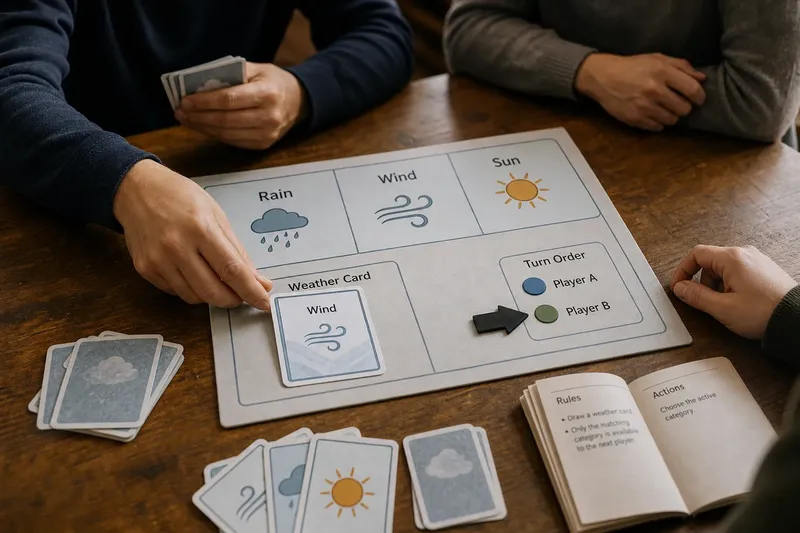
Say you are designing an invented classroom game. Its starting board has three printed categories—“Rain”, “Wind” and “Sun”—and one card space. A fictional rule says that drawing a weather card makes only its matching category available to the next player. The turn arrow begins beside Player A.
Player A’s starting inputs are the three fixed labels, an empty card space and the arrow pointing to A. Player A draws one fictional “Wind” card, places it in the card space, and moves the arrow to Player B. The observable result is that the labels stay in place, the card visibly identifies Wind as the active category, and the arrow identifies B as the next player. Player B’s decision is to choose Wind; if the card is absent or the arrow is unclear, the display does not support that decision, so the designer should correct the card space or turn cue before adding more decoration.
This example keeps the label, card and arrow to separate jobs. That makes it easier to tell whether confusion comes from a missing rule or an unclear visual signal.
How do these surfaces frame uncertainty?
A roulette layout puts categories in view, but their placement does not predict the outcome. A card table can show the current hand and turn, but a visible state does not make the next event certain.
The design distinction is what each surface asks players to attend to. A printed field helps them locate categories; a card table foregrounds the hand and the sequence of actions. Neither arrangement removes uncertainty, and clarity should come from accurate signals rather than implied promises about what will happen.
What do players need to know before acting?
Does a roulette layout show which result is more likely?
No. It displays recognised betting categories and their positions, not a prediction of the result. Treat the printed arrangement as an index for choices.
What belongs in a stable reference area?
Put rules, role names and category labels where players can find them without searching the active play area. Keep cards and turn indicators in distinct spaces when they communicate the current state.
Can a game combine a fixed board with changing turns?
Yes. A board can keep categories in place while cards or a turn indicator show what matters now. Make the difference between the printed information and the changing signal apparent.
How can a designer check whether a turn display is clear?
Ask someone unfamiliar with the design to identify whose turn it is, what information is visible and which action is permitted. If any answer is unclear, change the placement or add a dedicated cue, then ask the same questions again.
Make the next action legible without implying an outcome
For roulette layouts and card tables, begin with the player’s immediate question. Keep categories easy to locate when comparison matters; use distinct card areas and turn signals when players need to understand the current hand and sequence.
A clear design tells players where to look and what action the rules permit. It does not suggest that a layout or marker can tell them what will happen next.