Private Gaming Rooms and the Casino as Public Spectacle
Compare private-room and public-spectacle casino portrayals, and learn what images reveal about framing without mistaking them for proof of access.
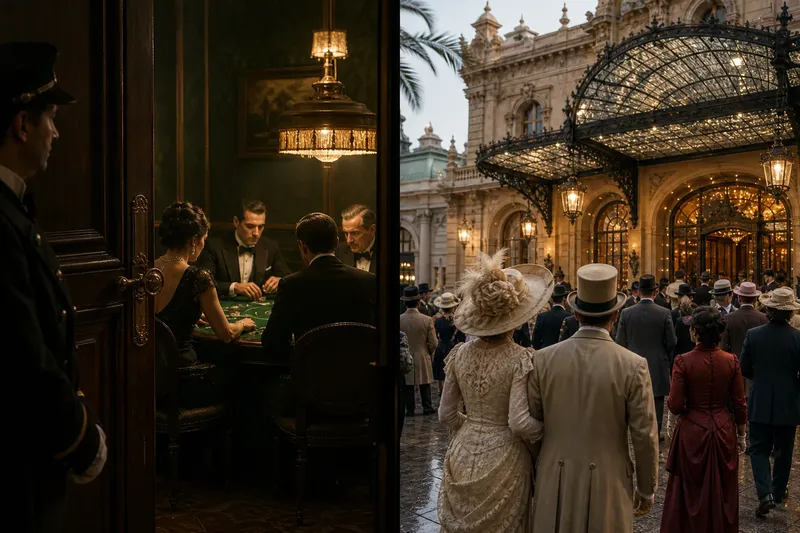
What can a casino image tell you about who could enter? Private gaming rooms and public spectacle are contrasting ways of framing casino culture, not proof of a historical transition between them. A film scene might centre on a guarded door; an advertisement might draw the eye to a crowded entrance.
Private rooms frame play as exclusive
A closed door, a small group and a card table can make access part of a scene’s meaning. The room appears set apart, and the audience is invited to read the gathering as private or prestigious.
In a film, novel or promotional image, those details describe how a portrayal constructs exclusivity. They do not establish who could enter a real venue, or how its rooms were used.
Public spectacle makes the venue visible
Other portrayals emphasise entrances, architecture, promenades or crowds. The casino becomes a destination to look at, while the scene may leave the game itself in the background.
This is a difference in presentation, not evidence of a single shift from secrecy to openness. A shop window offers a useful analogy: it shows selected goods while keeping the stockroom out of sight. Likewise, a public-facing image can show a grand entrance without revealing entry rules, private areas or working spaces.
Record what an image actually shows
For a careful comparison, choose identifiable material such as a dated film scene, a captioned archive photograph or a travel advertisement. Write down the source and date when available, describe visible details, and mark missing information as unknown rather than guessing from style.
- Source and date: Check for a named creator, publication or date. If these are present, record them; if not, mark them unknown and avoid a period-specific claim.
- Setting: Check whether the frame shows a closed room, entrance or shared interior. If a boundary is visible, describe it; if not, do not infer unrestricted access.
- People: Check who appears to be playing, working or watching. If roles are unclear, record them as unclear; otherwise, describe only what the image supports.
- Viewpoint: Check whether the viewer seems placed outside a doorway, among a crowd or beside a game. If the position is apparent, note it; if not, avoid guessing the intended audience experience.
- Visual emphasis: Check whether the table, entrance, architecture or crowd draws the eye. If one feature dominates, record it; if attention is divided, describe the competing details.
- Accompanying words: Check any caption or promotional copy for terms such as “exclusive” or “grand”. If wording appears, quote or paraphrase it accurately; if there is no text, do not attribute a message to the creator.
- Evidence about access: Check whether the item states entry rules or everyday use. If it does, keep that information distinct from visual interpretation; if it does not, limit the conclusion to what the portrayal makes visible.
Say you have two invented items: a fictional film still with a guarded doorway and a fictional travel illustration showing a crowd at a casino entrance. You record their invented source details and find that neither gives entry rules; then you describe the first as framing restricted access and the second as framing arrival and public attention. The comparison supports a claim about different presentations, but it cannot establish that a real venue became more accessible.
What can casino portrayals establish?
Why does a private room signal status?
A closed door, selected company and elaborate surroundings can make exclusion visible to an audience. That supports a reading of how the scene signals privilege, not a claim about who could enter a real room.
What makes a casino portrayal feel like public spectacle?
Entrances, shared interiors, crowds and architecture can make the venue itself the focus. These choices present it as a place to visit or observe without proving that everyone had access.
Can an image show who was allowed to enter?
An image shows who appears in that particular frame, not necessarily the full rules of entry. Look for separate documentation about the venue and period before making a claim about access.
How should I compare casino images from different periods?
Record each item’s source and date, then ask the same questions about setting, people, viewpoint and emphasis. If either item lacks reliable dating, describe the contrast without presenting it as evidence of historical change.
Keep claims about casino culture close to the evidence
Return to a visible detail, such as a doorway or crowd, and ask what the source lets you say. A doorway may frame exclusion in a film, while an entrance may dominate an advertisement; those observations describe the items, not a proven change in everyday access.
Use “private gaming rooms and public spectacle” to name a contrast in representation when the sources support it. Keeping that distinction clear helps readers see both what an image reveals and what it leaves unanswered.